- DK NEJET
You Can’t Shoot a $20,000 Drone With a $1 Million Missile Forever
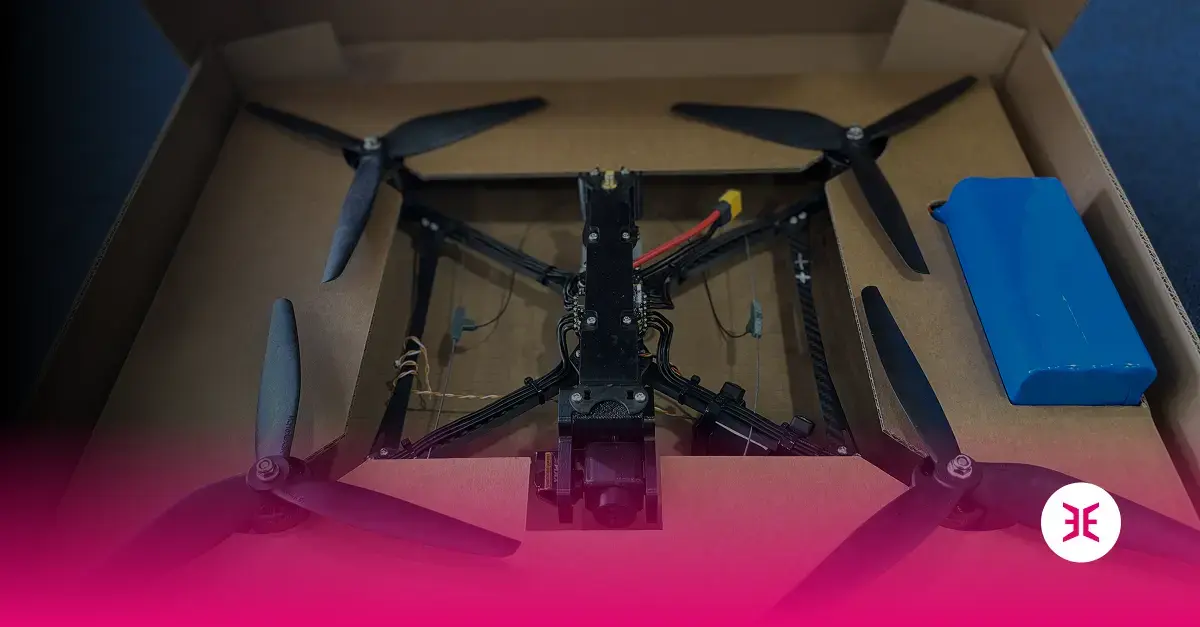
The asymmetry everyone talks about is told from the attacker’s side of the ledger. The more urgent problem is the defender’s. You can intercept every threat and still lose — if each interception costs more than the thing it stopped, and the magazine runs dry before the adversary does.
There is a number that has become impossible to avoid in defense commentary this year. A drone costs twenty thousand dollars. The missile that stops it costs two to four million. Write the ratio on a slide and the conclusion looks obvious: cheap mass beats expensive precision, the attacker wins, and the defender is on the wrong side of history.
Ukraine has already lived the other half of that conclusion, and it is more complicated than the slide suggests. In early 2022, when few observers gave the country more than a handful of days to withstand a full-scale invasion, the fight was still a battle of heavy armor. That changed quickly. On June 10, 2022, operators from a Ukrainian battalion carried out what is widely regarded as the first successful combat FPV-drone strike — a weapon costing a few hundred dollars that altered the arithmetic of the battlefield. The way war is fought changed that day. Yesterday, on June 11, 2026, Ukraine marked its first-ever Day of the Unmanned Systems Forces — a national holiday for a branch of the military that did not exist when the war began.
The armor did not disappear. Tanks still matter. But the ratio had tipped, and it tipped toward the smaller, cheaper, unmanned system. That is the asymmetry everyone now studies.
It is also only half the lesson. The asymmetry story is almost always told from the attacker’s side of the ledger — how little it costs to threaten, how much it costs to be threatened. The side that matters more, and gets discussed less, is the defender’s. Because the defender’s problem is not that the adversary’s systems are cheap. It is that our own answer to them is scarce, expensive, and slow to replace. And that is a problem we built ourselves.
The Tactical Win That Loses the War
Consider what happened over a NATO member’s territory in September 2025. A number of drones crossed into allied airspace. They were brought down — successfully — with air-to-air missiles costing roughly a million dollars each. The drones were estimated at up to twenty thousand. Every interception was a tactical success. Collectively, they were an economic defeat.
Now scale that exchange across a sustained campaign. In a major regional air war in 2025, one nation’s defenses expended, by credible public estimates, around a quarter of an entire class of high-end interceptors in under two weeks. Stockpiles of another widely fielded system reportedly fell to a quarter of the level planners considered necessary. The systems worked. They hit what they were aimed at. And the side defending still ended the period materially weaker, because every engagement spent a resource that takes months or years to rebuild.
This is the part the cost-exchange slide leaves out. A defender can win every single interception and still lose, because air defense is not decided by hit rate. It is decided by the magazine’s depth. The relevant question is not “can we stop this threat,” but “how many times can we afford to?”
“You can win every interception and still lose the war — if each win costs more than the threat it stopped, and your magazine empties before the adversary’s does.” — Co-founder, DK NEJET GROUP
We Built Air Defense for Half the Threat
The reason the math has turned against the defender is structural, and it predates any particular conflict. Modern air defense was designed for a world of few, expensive, high-value threats — ballistic missiles, advanced aircraft, cruise missiles. Against that world, an exquisite interceptor that costs millions is entirely rational. The threat is rare and catastrophic; the response can be rare and costly.
That world has not gone away.
Ballistic missiles still demand a Patriot, a THAAD, an Arrow, and nothing cheaper will do. Those systems remain indispensable — and the recent strain on their stockpiles is proof of how much they are still needed.
What changed is that a second tier of threat was layered on top of the first.
Cheap, uncrewed, and arriving in volume, it does not require an exquisite answer, but in most arsenals, an exquisite answer is the only one available. So the million-dollar interceptor built to stop a ballistic missile gets fired at a twenty-thousand-dollar drone, because there is nothing else to fire. That is the structural failure: not that high-end interceptors exist, but that no affordable tier was ever built beneath them to absorb the volume.
The cost of that gap is not only measured in dollars. Every exquisite interceptor spent on a cheap, low-value target is one no longer in the magazine when the threat it was actually built for arrives. The supply chain makes this worse. High-end interceptors are produced in the hundreds per year, often through single facilities, with allied nations now drawing from the same finite pool. Independent analysts have put it plainly: the defending side is expending interceptors faster than industry can replace them.
That is not a hit-rate problem that better missiles will solve. It is an allocation problem and an economics problem. And you cannot buy your way out of it with a more expensive version of the thing that created it.
Cheaper Interceptors Are Necessary, but Not Sufficient
The instinct, increasingly, is to chase a cheaper shot. Directed-energy weapons promise interception at a few dollars per engagement. Low-cost interceptors aimed specifically at one-way attack drones are entering development across the industry. This is the right direction, and it is overdue.
But again… it is only HALF the answer, and the easier half.
A cheaper interceptor still has to find the target, decide to engage, and connect — at machine speed, against many threats at once, often while the adversary is actively degrading the sensors, links, and navigation the defense depends on.
The directed-energy systems held up as the solution have been delivered but, by mid-2026, have barely been used in real engagements. The reason is rarely the energy itself; rather, it’s everything around it: cueing, tracking, and coordination under degraded conditions.
This is the point the cost conversation keeps missing. Affordability without coordination is not a system. It is a pile of cheap units. Replacing one expensive, fragmented architecture with a cheaper, equally fragmented one does not fix the math — it just lowers the unit price of losing.
The Coordination Layer Is the Answer
The defender’s economics only invert back in their favor when two things are true at once. The interceptor has to sit at the cost tier of the threat — measured in thousands, not millions. And it has to be coordinated by a software layer that lets one operator direct many units as a single force, holding the line when communications are jammed and navigation is unreliable.
That second condition is the one hardware-first thinking skips, and it is the decisive one. The economics are not a property of any single cheap unit. They are a property of the layer that orchestrates them — that decides, cues, and adapts faster than a human crew could, across more threats than a human crew could track. Software is what converts a low unit cost into a sustainable cost-exchange ratio. Without it, cheap mass is just a discount on the same problem.
This is not theoretical. In 2025, a single unit operating attritable interceptors and strike systems built on this logic neutralized $6.1 million in targets at roughly fifteen times the cost it expended — while preserving high-end air-defense missiles for the strategic threats only they can stop. Those results come from real hardware and people with direct combat experience, not from a slide. The coordination layer is what makes them repeatable, and what lets them scale.
Where This Understanding Comes From
Knowledge like this is not produced in a laboratory. It is produced in the only environment that has been forcing the question continuously for three years. Ukraine has been the most demanding electronic-warfare environment on the planet, where jamming, spoofing, and adversary adaptation change by the week, and where a defense that assumes clean conditions fails on contact. The engineers and operators working there are not iterating against a threat model. They are iterating against a live opponent that updates faster than any exercise cycle.
The result is a compression of years of development into lived operational reality — and, critically, it is transferable. The systems and the doctrine built under those conditions can be adapted into allied frameworks. That is not a future ambition. It is happening now, because the threat environment does not wait.
The Procurement Question
Europe is, to its credit, beginning to act on this. NATO has started building a marketplace for counter-drone systems and is openly exploring new ways to buy — challenge-based procurement, capability as a service, leasing — precisely because the old requirement-driven cycle is too slow for technology that changes in weeks. The funding is committed. The institutional will is there.
What remains unresolved is whether the cost-exchange logic actually gets built into what gets bought — or whether it stays a line in policy reports while procurement keeps funding exquisite answers to cheap problems. The defender’s economics will not fix themselves. They are a design choice. The side that treats affordability and coordination as a single architecture, rather than two separate purchases, is the side that can still afford to defend itself a year into a sustained fight.
The asymmetry everyone is worried about is real. But it is not destiny. It is arithmetic — and arithmetic can be changed, by the side willing to change how it does the math.
This editorial draws on publicly available defense policy documents, procurement announcements, and operational reporting from 2025–2026. The author works in autonomous systems and software-defined air defense.
The Next Decade’s Best Bet: Why Defense Tech Is the New Software

DK NEJET in Oslo – We’re Exhibiting at FSi Exhibition 2026

DK NEJET Group Hosts Latvian Minister of Defence

The Illusion of a Magic Button: Why Autonomy Alone Won’t Change the Battlefield