


- Events
Eurosatory 2026: What Our Team Took Away From Paris
Five days at the world’s largest land-defence exhibition, in the words of the people who were on the ground.
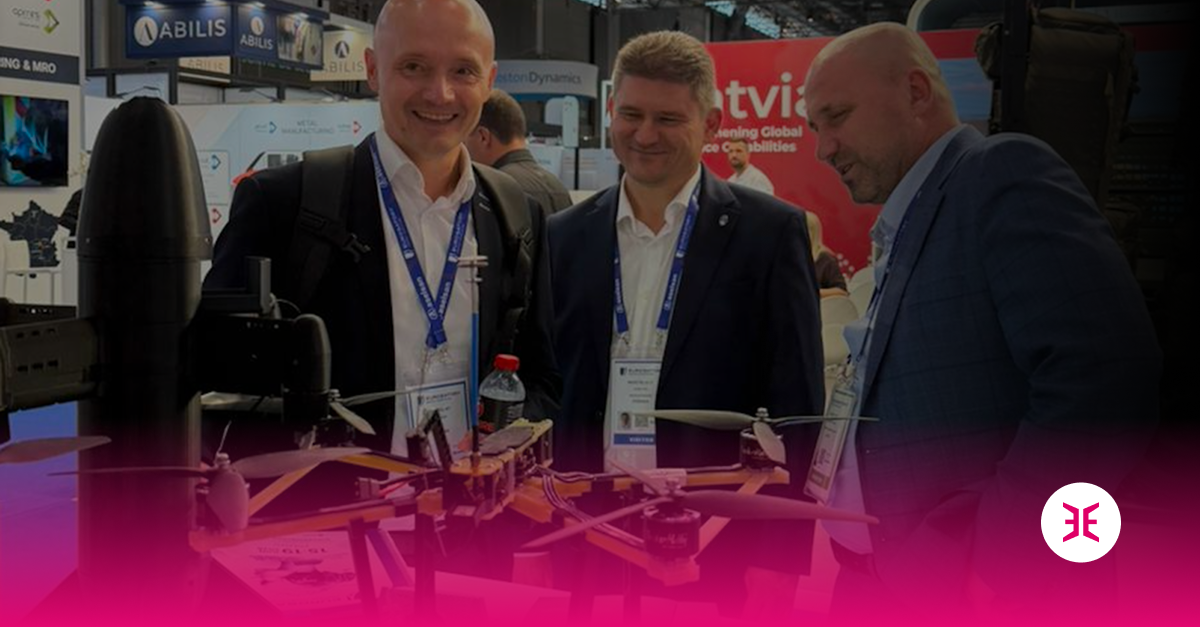
Eurosatory 2026 ran from 15 to 19 June at Paris-Nord Villepinte — five days, more than two thousand exhibitors, and a floor that was bigger again than the last edition. Most of the week was spent at the Latvian national pavilion, in back-to-back conversations with current and prospective partners across Europe, the Middle East and Asia.
Rather than file a tidy summary, we asked the people who were actually there what stayed with them. A few clear themes emerged.
“The whole sector is still accelerating”
The first thing the show tells you is its own size.
“The show grew again this year. That tells you something simple — the sector is still accelerating, there’s no plateau in sight.” — Aleksandrs Stupans, Business Development Manager (Latvia)
Aleksandrs spent almost the entire week at our stand, which is where the real work happens: meeting current and future partners and mapping out the next steps for getting our technology into new markets.
Europe has discovered drones, but still treats them in pieces
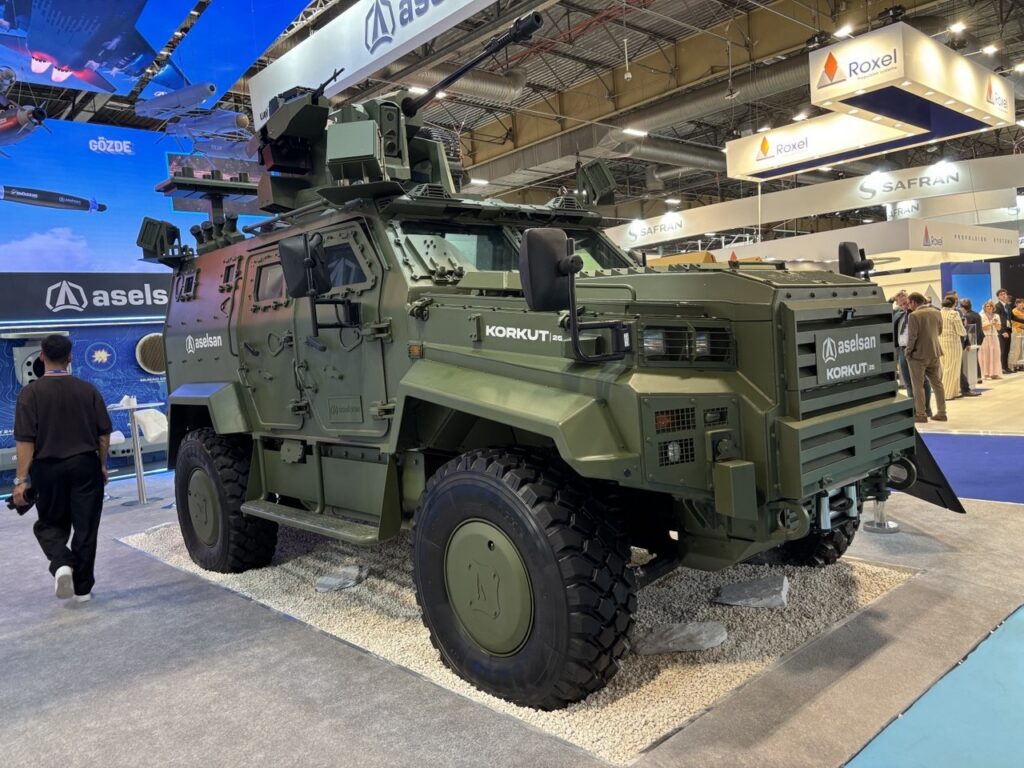
Two years ago, unmanned systems were nearly a footnote here; the floor belonged to heavy platforms – this started to change, but the way the market approaches the problem hasn’t yet.
“Europe still tends to treat this in three separate boxes — the hardware, the software, the operator training. Our advantage is that for us they’re one thing. And Ukrainian systems aren’t just ‘something that flies’ — they’ve been proven without GPS, under jamming, with constant feedback from the people actually using them.”
That feedback loop — refinement through direct input from people with direct combat experience — is the difference between a system that performs in a demonstration and one that holds together when communications are degraded and conditions change mid-mission. It is also why our platforms carry NATO codification, have been approved and implemented across three national ministries of defence, and are in service with more than 90 frontline units, supported by a team of over 160 people, many of whom have direct combat experience.
The trend everyone agreed on: autonomous interceptors
If the show had a single headline, partners and the wider floor kept pointing to the same one.
“There was real attention on the Ukrainian stands. Where we’re clearly ahead is the cheap, simple solutions that actually scale. The headline trend is autonomous interceptors — nobody has a fully finished product on the market yet, there are a lot of partial answers. The market is moving toward full autonomy; the question is who gets there in a way that works.”
The pull toward affordable interception is not about replacing high-end air defence. Those systems remain indispensable against ballistic and strategic threats. The gap is beneath them: no affordable layer was ever built to absorb the volume of cheap drones now saturating the airspace. A low-cost interceptor that closes airspace against a reconnaissance drone does not replace a high-value system — it protects it, preserving expensive munitions for the threats that genuinely need them. That is the role our NIKNS SUNS interceptor line is built for.
Another team member made the same point from the artillery side:
“Eurosatory has always leaned heavy — artillery, armour. This year you could feel people starting to accept that the proportions have to change. Heavy systems still matter, but not by heavy artillery alone: it’s expensive, and it can’t answer a drone.”

Everyone wants “fully autonomous.” Few have thought through what that means.
The most revealing conversations were about autonomy — and how quickly the request changes once you examine it.
“The counter-UAS makers don’t want a pitch — they want us to finish automating the final phase of the interception so they can integrate NS3 into their systems straight away. The interest in ready-to-field kits was just as strong: a training course with the drones to match it, a backpack set for mobile patrols, configurations for patrol vessels. Partners want something they can put in front of a customer, not a component.” — Aleksandrs Stupans, BDM
The instinct everywhere is to ask for total automation. But when the conversation goes one level deeper, the position softens.
“Everyone says they want a fully autonomous system. The moment you ask whether they really want an AI deciding everything for them — like in some film — they back off. That’s exactly our point.”
This is where our design philosophy lands.
Take NS3: it can lock onto a target and, once an operator confirms the engagement is clear, arm and complete the strike — but if conditions change, if the picture is no longer clear, it can just as readily disarm and return. The idea is:
- The autonomy handles what is too fast for a human
- The human keeps the decisions that should never be left to a machine. Meaningful human control is not a constraint we are trying to engineer away. It is the design that we want to keep.
A new route into France
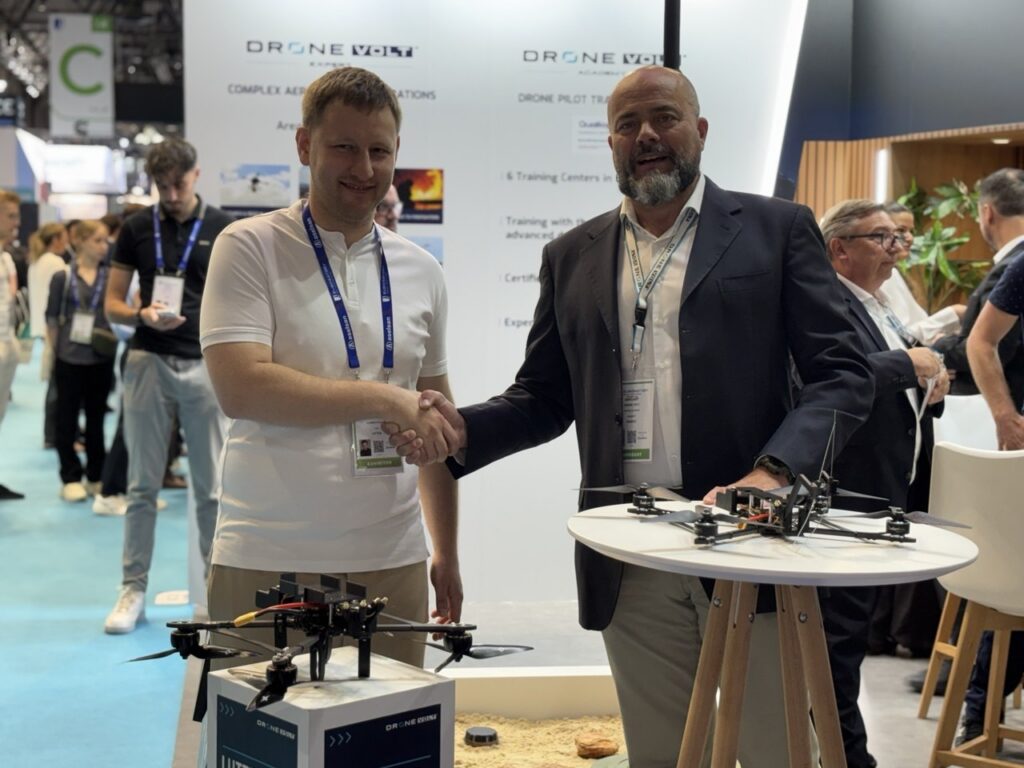
The week also moved our footprint forward commercially: through our sister entity DK Unity, we concluded a distribution agreement with Drone Volt that opens a direct route into the French market for our interceptor systems.
Where this leaves us
Put the observations together and the signal is clear. The market is moving toward autonomy and toward systems — but there is a wide gap between talking about AI and building it, and much of the floor is still on the talking side. As Olga put it: plenty of partial answers, no finished one. Autonomy that survives a contested environment cannot be assembled from a slide; it has to be designed for degradation from the start, and tested where degradation is the norm.
That is the work our team has been doing — and, judging by Paris, the work the market is finally coming round to.
